Manhattan Innovation Story: Man at the Crossroads
A Walking Tour Through Six Technological CrossroadsA Walking Tour Through Six Technological Crossroads
A tour following six key sites in Manhattan's technological and architectural history
Introduction: An Anthropology of a CityIntroduction: An Anthropology of a City
The guiding hypothesis of this tour is that Manhattan is built on a fundamental split - between what's below and what's above, between the machine and the interface, between exposed technology and the respectable façade. We'll see this split again and again at each of the six stops. The tour is a journey following this split: where it was born, how it became embodied in concrete and glass, and where it's taking us today.
#1 The roots: a tower or a factory?#1 The roots: a tower or a factory?
Where we are: The intersection of Chelsea and the Meatpacking District. Around us: old industrial buildings, some have become artists' studios, some boutique hotels, some luxury apartments.
It was once written of Bell Labs that they were "an ivory tower with a factory downstairs." That sentence is the key to the entire tour.
Think for a moment about what that sentence assumes. It assumes two separate worlds: a world of pure thought - the ivory tower, a place of ideas, of light, of respectability - and a world of production - the factory, a place of dirty hands, of noise, of machinery. They live together in the same building, but they are separate. One above, one below.
This is the story Manhattan wants to tell about itself. But notice - where is the factory here? Where is the floor below? We're standing on the remains of an industrial city. Meatpacking was once a wholesale meat-packing district, that's where these streets get their name. The High Line we'll walk on shortly was an industrial rail line that ran through the factories themselves. NABISCO - the National Biscuit Company factory that stood here, is now Chelsea Market, an artists' market and gourmet food hall. The Westbeth Complex, which once sat at the heart of the Bell Labs compound, is now an artists' residence.
The machine here is dead. And not just dead - it has become an aesthetic backdrop. The industrial steel, the high-ceilinged halls, the rusted rails - all of these turn the environment into the perfect setting for "authentic urbanism." What was once a roaring factory has become an artist's studio. What was once a workplace for laborers has become a bar where you pay twenty dollars for a cocktail. Heavy technology was pushed back - to New Jersey, and to China - and New York remained with its beautiful memory.
This is the first stage of the split. But to understand how we got here, we need to go back, to the moment when the split had not yet been decided. We need to go to Rockefeller.


"an ivory tower with a factory downstairs." NY times about Bell Labs
#2 GE | Rockefeller#2 GE | Rockefeller
Where we are: The Rockefeller complex, the heart of Manhattan. The buildings around us were built in the 1930s. Above - the famous photograph of workers on a steel beam over the street. Below, in the entrance hall - the murals of José María Sert.
John D. Rockefeller was one of the greatest figures capitalist America ever produced. The historian Lawrence Freedman describes him in words worth listening to:
"Rockefeller was undoubtedly a master strategist. He could take a view of the system as a whole and assess the position of the individual parts... both strategist and supreme commander, directing his lieutenants to move with stealth and speed and with expert execution."
Rockefeller thought of the city as a battlefield. He spoke in military metaphors: "what general of the Allies ever sends out a brass band in advance with orders to notify the enemy that on a certain day he will begin an attack?" He didn't see himself as building buildings. He saw himself as building an empire. And here, in this complex that bears his name, that empire reached its supreme expression.
Now look at the famous photograph - Lunch atop a Skyscraper. Eleven workers sit on a steel beam above the street, eating sandwiches, smoking. The photograph is iconic - a symbol of courage, of masculinity, of American progress. But notice what the photograph doesn't show: it's staged. The workers weren't actually on a lunch break - they were positioned there by Rockefeller's photographer. They were a prop in a PR campaign.
And more importantly - there is no monument anywhere in New York to the workers who fell building it. Hundreds of workers died building the skyscrapers, the bridges, the infrastructure that shaped the skyline. None of them got a statue. They enter the story only as a blurred collective, "the dust of humanity" that the labor of Rockefeller and his sons managed to mold into a city. The statues belong to the magnates - those who "envisioned the future."
Let's go into the lobby of 30 Rockefeller. There, on the walls, is the holy of holies of capitalism. And there is the point where everything splits.


Rockefeller was undoubtedly a master strategist. He could take a view of the system as a whole and assess the position of the individual parts. Yergin describes Rockefeller as “both strategist and supreme commander, directing his lieutenants to move with stealth and speed and with expert execution.” He was not averse to military metaphors, for example, justifying his secretive methods by wondering “what general of the Allies ever sends out a brass band in advance with orders to notify the enemy that on a certain day he will begin an attack.” Chernow describes him brooding over problems. Plans were “quietly matured plans over extended periods. Once he had made up his mind, however, he was no longer troubled by doubts and pursued his vision was undeviating faith.” But because his strategic success was the result of objectionable methods and in pursuit of retrograde aims, he could hardly be presented as the model for an aspiring businessman.
L. Freedman. Strategy: a History (p. 478). Oxford University Press. Kindle Edition.
Man at the CrossroadsMan at the Crossroads
The original painting commissioned for the Rockefeller lobby was by Diego Rivera, the Mexican socialist artist. It was called Man at the Crossroads. At the center of the painting stood a worker holding the controls of a giant machine. On one side - a vision of capitalist exploitation. On the other - a vision of socialist redemption. And in the background, Rivera painted the face of Lenin.
That was too much for Rockefeller. He demanded that Rivera erase Lenin. Rivera refused. Rockefeller ordered the destruction of the painting.
On the ruins of Man at the Crossroads were painted the murals we see today - Man, Controller of the Universe - by José María Sert. These murals cannot be understood without knowing what they replaced. They are written on blood.
The murals tell an evolutionary story of Man, and alongside them these lines are inscribed:
"Man labouring painfully with his own hands: living precariously and adventurously with courage fortitude and the indomitable, will to survive."
Man at his beginning - naked, raw, struggling.
"Man the creator and master of the tool. Strengthening the foundations and multiplying the comforts of his abiding place."
Man becomes master of the tool.
"Man the master and servant of the machine, harnessing to his will the forces of the material world, mechanising labour and adding these to the promise of leisure."
And then the critical transition - Man becomes both the master and the servant of the machine. The machine serves him, but he serves it. He harnesses the forces of nature, but he is part of the machine. And the promise at the end of the road - leisure. This is the final goal of all toil. The workers suffer now so that future generations can rest. And then, in the middle of this Greek-Babylonian scene - deus ex machina. Another figure enters the picture:
"Man's ultimate destiny depends not on whether he can learn new lessons or make new discoveries and conquests, but on his acceptance of the lesson taught him close upon two thousand years ago."
With no warning, no preparation, the Christian gospel arrives. The bodies are clothed. The faces brighten. Progress and redemption merge. And only in the back - if you look closely - appear ugly figures turning their faces away from the gospel. Their noses give them away. The Jews. They are the only ones in the painting who don't buy the story.
This is Rockefeller's axis: the machine below, the gospel above, and in between the American hero whose figure is Lincoln - emancipator of slaves, the unified Christian-capitalist vision.
But this is only the vision. In practice, this axis fell apart. Let's see how.


Man, Controller of the UniverseMan, Controller of the Universe
Man labouring painfully with his own hands: living precariously and adventurously with courage fortitude and the indomitable, will to survive.
Man the creator and master of the tool. Strengthening the foundations and multiplying the comforts of his abiding place.
Man the master and servant of the machine, harnessing to his will the forces of the material world, mechanising labour and adding these to the promise of leisure.
Man’s ultimate destiny depends not on whether he can learn new lessons or make new discoveries and conquests, but on his acceptance of the lesson taught him close upon two thousand years ago.
#3 590 Madison Avenue | AT&T | Sony | Chetrit#3 590 Madison Avenue | AT&T | Sony | Chetrit
Where we are: The building designed by Philip Johnson, formerly AT&T headquarters, then Sony headquarters, now owned by the Chetrit Group. Nearby also stand the IBM Building (590 Madison) and 51 Astor Place.
This building is a landmark moment in architectural history. When Philip Johnson designed it for AT&T in the 1980s, he did something that had been forbidden: he placed a broken pediment on top of the skyscraper - a giant half-circle with a notch in its middle, like the crown of a Chippendale chair. For the first time, an American skyscraper declared itself to be a quotation. It looks backward, at Victorian furniture, at another culture.
This was the moment postmodernism announced its arrival in America.
But what interests us here is the chain of owners. The building was built as the headquarters of AT&T - the largest telecommunications company in the world. One of its sisters was Bell Labs, that same "ivory tower with a factory downstairs." AT&T were still from the old generation: an industrial-technological company that produced infrastructure. They commissioned a building that would be a monument to their industrial power.
Then AT&T broke up. The building was sold to Sony. Sony was the next stage: still producers, but producers of end products - televisions, Walkmans, PlayStations. Not infrastructure. Electronic consumerism. And Sony, in turn, declined.
The building was sold again - to the Chetrit Group, real estate developers. Now it's not the headquarters of a tech company. It's luxury apartments. The building stopped being a place of making and became an asset.
This is the rapid sequence: from industry → to trade → to real estate. In one generation, a skyscraper that was supposed to be a monument to production became a symbol of something else entirely - speculation.
And along the way, something disappeared. The floor below. The factory. It was simply erased from the equation.


#4 550 Madison Avenue#4 550 Madison Avenue
Where we are: The adjacent building, a symbol of the same process, and in a sense the climax of the disappearance.
It's worth noting that this building, whose crown was once a revolutionary architectural statement, becomes within thirty years just another piece of luxury real estate. The sculptural quality, the cultural statement - all of it dissolves into market prices. A building that once spoke of industry, then of consumption, now speaks of capital storage.
This is the lesson of New York postmodernism: the architectural quotation becomes a financial quotation. The building is no longer a home - it's a speculator.

#5 GM | Apple Store#5 GM | Apple Store
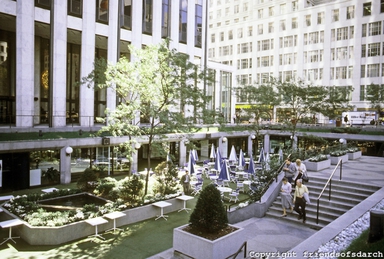
Where we are: The entrance to the GM Building, home of the famous Apple Store - the glass cube above an underground retail space.
Look at what happened here. This site once held the General Motors Building - a monument to the American auto industry. GM became the symbol of the American machine. If Rockefeller was the capitalism of oil, GM was the capitalism of steel and engines. The Sunken Plaza of GM was pure modernist vision.
And now, on the same ground, sits the Apple Store.
And not just a store. The entrance to the store is a transparent cube - a glass temple. Think about a cultic temple - the Kaaba in Mecca is a black cube, with a black stone inside it. The Apple cube is precisely the opposite: it is white, it is transparent, it does not hide. Apparently.
But what's beneath? Below it teems an underground human chaos. Thousands of fingers touching, swiping, turning. Noise. Sweat. Crowding. Once again, the same structure: respectability above, machine below.
What does Apple sell? Not technology. Protection from technology. Every Apple product is described in terms of what you don't see: no buttons, no wires, no screw you can open. They manage to wrap technology so beautifully that you never have to deal with it. You only see the interface. The transparency isn't incidental - it's a declaration. We'll deal with the technology. You get the interface.
This is the precise echo of Rockefeller's murals. Above - sublime, clean, transparent. Below - the machine, the labor, the effort. But Apple has taken the story one step further. With Rockefeller, the workers were at least allowed to appear in the painting - ugly, naked, but present. With Apple there are no workers anymore. They've been hidden in China. We see only the interface.
There's also a chilling parallel here. The Holocaust memorial in Boston consists of six tall transparent structures, like chimneys, with a machine humming beneath them. Numbers stream across the glass. The architectural structure of atrocity and the architectural structure of a tech temple are the same structure: transparency above, machine below. That shouldn't frighten us occasionally - it should frighten us consistently.
The bitten apple of Apple is the perfect symbol of contemporary New York: a city that has eaten from the Tree of Knowledge and declares itself unashamed. A city that detaches the fruit from the tree, hides the process of production, and locks itself away in the illusion of the interface.
.jpg)
#6 The End#6 The End
Where we are: The South Pool of the 9/11 Memorial. Water falls into a great black square. The bottom is invisible.
We end here. There's a reason.
Throughout the tour we've spoken of a split - between what's below and what's above, between machine and interface, between industry and real estate. The split has been working all along. It produced a city that is, at the same time, grandiose and unstable, solid and entirely dependent on the teeming infrastructure beneath it.
On September 11, 2001, this split collapsed literally. Into itself. The buildings - monuments of "World Trade" - fell into the ground. In their place remained black holes. Water flows into them without a bottom.
Reuven Namdar, an Israeli-American novelist, wrote it like this, in The Ruined House:
"O Manhattan, isle of the gods, home to great happenings of metal, glass, and energy, island of sharp angles, summit of the world!... One day the subway cars will leap off their rails and plunge into the depths of the earth, severing the last cables that anchor the city to the ground. Our island will be torn loose, ripped from its rocky underpinnings; it will ascend into the sky and pierce it like a fast, shining bullet. The rivers will foam and cascade, immense tides pouring into the gaping wound. When calm returns, the quiet will be unearthly."
Namdar didn't predict 9/11. He described the internal logic of New York itself. A city that plans itself so tall, that purifies the respectable from what lies below, that builds the illusion of a pure interface - is a city whose potential for collapse is built into it. Not by accident. By structure.
Remember the passage from Pirkei DeRabbi Eliezer about the Tower of Babel: the builders climbed up one side, came down the other, building the tower ever higher. "If a man fell and died, they paid no attention to him; but if a brick fell, they would sit and weep and say: When will another brick come up in its place?" This is New York. A city in which the brick - the asset, the building, the capital - is worth more than the human being. And a city that knows, somewhere deep within itself, that it was built on this split. And that this split is what will bring it down.
This memorial doesn't only tell of a terrorist attack. It tells of something deeper: of the possibility that the great edifice of New York - of global capital, of the transparent interface - is built atop an empty floor. And that one day that floor will, simply, open.
The water falls without a bottom. This isn't only memory. It's a warning. And perhaps also a declaration: that it may no longer be possible to stop the machine.

O Manhattan, isle of the gods, home to great happenings of metal, glass, and energy, island of sharp angles, summit of the world! Have not we all-rich and poor, producers and consumers, providers and provided for-been laboring for generations with all our might, under the direction of an unseen Engineer, to build the most magnificent city ever known to humankind?We lay down more avenues, rule them straight, strive to get the proportions of their buildings right. We pour our lifeblood into the foundations of the skyscrapers, raising them ever higher: the Empire State Build-ing has added two stories in the last decade; the Twin Towers near the Battery will grow by half in the next century. Slowly, imper-ceptibly, we deepen the rivers encircling our island: the Hudson is twice the depth it was when glimpsed by the first white settlers. The East River would be, too, were it not for the toxic wastes we continuously dump into it, rendering our own efforts Sisyphean. Everything soars, rushes, accelerates: the Dow Jones Industrial Average, the rate of population growth, the bribes needed to flout municipal building codes, the hire of the whores, the price of pedigreed dogs, subway fares, real estate values. The bridges stretch farther and farther; the tunnels linking us to the heart of the continent grow deeper and deeper. The conical water tanks on the rooftops strain toward the heavens, pulling the buildings behind them as if to detach them from their foundations.
One day the subway cars will leap off their rails and plunge into the depths of the earth, severing the last cables that anchor the city to the ground. Our island will be torn loose, ripped from its rocky underpinnings; it will ascend into the sky and pierce it like a fast, shining bullet. The rivers will foam and cascade, immense tides pouring into the gaping wound. When calm returns, the quiet will be unearthly. Only large, low-flying seabirds will hover over the face of the depths.
The Ruined House, R. Namdar